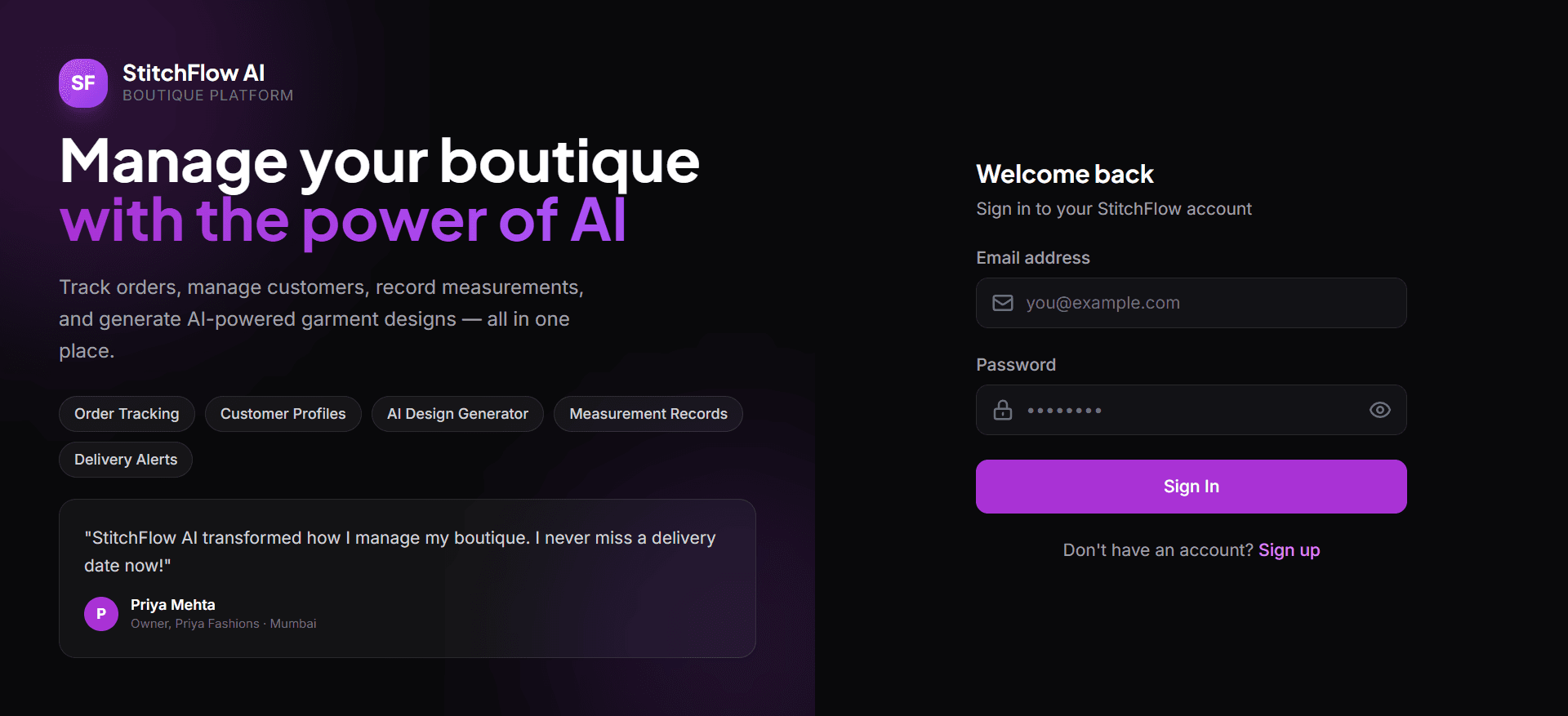
StitchFlow AI
From paper notebooks to AI-generated designs: a boutique management platform built for tailors.
- Role
- Product design & full-stack development
- Timeline
- March 2026
- Platform
- Web app · SaaS
- Toolkit
- React 18 · Vite · Tailwind CSS · Node.js · Express · MongoDB · OpenAI
01
The spark
Tailoring runs on trust, measurements and deadlines.
In many small boutiques, measurements live in notebooks and orders live in chats and memory. When the shop gets busy, details get lost and delivery dates slip.
StitchFlow AI is my own SaaS project to digitise that daily work, and to explore how AI can help boutiques sell designs, not just stitch them.
02
The challenge
The people using it aren't software people.
Give a busy boutique one calm place for customers, measurements, orders and deliveries, and make it smarter with AI.
The product had to be quick to learn, organised around the shop's real workflow, and dependable enough that no delivery date is ever missed.
03
The approach
Designed and built end to end.
I owned everything from the focused dark UI to the API and the database, so the design could follow real data.
- 01
Workflow-first structure
The app follows the shop's day: customers and their measurement records, orders with their own detail pages, a dashboard, and notifications for what's due.
- 02
AI where it adds value
An AI Design Generator uses OpenAI's GPT-4 and DALL·E 3 to turn a description into garment design ideas a tailor can share with customers.
- 03
A secure, real backend
Node.js and Express with MongoDB store the data, JWT access tokens and bcrypt protect accounts, and Nodemailer sends email updates.
04
The work
What I designed and built
Order tracking
Every order with its status, details and delivery date in one place.
Customer profiles & measurements
Customer records with saved measurements, ready for the next order.
AI design generator
Describe a garment and get AI-generated design concepts to discuss with customers.
Delivery alerts
Notifications and reminders so upcoming deliveries never slip through.
05
The outcome
Open source on GitHub.
- Screens designed & built
- 10+
- Core modules
- 5
- AI models, GPT-4 & DALL·E 3
- 2
StitchFlow AI's code is public on GitHub, covering sign-up and login, the dashboard, customers, measurements, orders, AI designs, notifications and profile.
It's the project where my design and full-stack skills meet: I shaped the experience and wrote the code behind it.
06
What I learned
What I'm taking forward
- 01
Designing for non-technical users means fewer screens, clearer labels and obvious next steps.
- 02
AI features need a clear job. Generating design ideas is useful; generating everything isn't.
- 03
Owning the API changed my UI decisions: I designed around real data, not ideal data.